Occupation Orders
An occupation order is a court order that can decide who is allowed to live in or enter the family home. It may be appropriate where domestic abuse has made it unsafe or unworkable to continue living together, including where emotional abuse or controlling behaviour is a concern. National Legal Service Solicitors can explain your options, including urgent applications and whether legal aid may be available.

What does an Occupation Order do?
An occupation order regulates who can occupy the family home and is an important part of family law. Depending on the circumstances, it may allow you to remain in or return to the property, require the other person to leave or prevent them from entering all or part of the home.
The court can also exclude someone from a specified area around the property where this is necessary. Occupation orders are made under Part IV of the Family Law Act 1996 and are intended to deal with occupation of the home, rather than the long-term ownership of it.
These orders are only issued in particularly serious circumstances, such as when domestic abuse or an irreconcilable relationship breakdown has taken place. They are sometimes used in conjunction with non-molestation orders, which help to prevent harassment and allow an individual to continue with their life within the family home. As a result, there are stringent criteria which lead to these orders being granted as they are considered to be draconian in nature, and expert guidance is needed to ensure an accurate application is submitted supported by strong evidence.
What’s the difference between an occupation order and a non-molestation order?
Both, occupation orders and non-molestation orders can be used where domestic abuse is a concern, but they address different parts of the situation. An occupation order focuses on living arrangements and the family home, while a non-molestation order focuses on protection from abusive behaviour.
The court will consider the circumstances of each case, including safety, housing needs and any children involved. In some cases, applying for both orders may be appropriate.
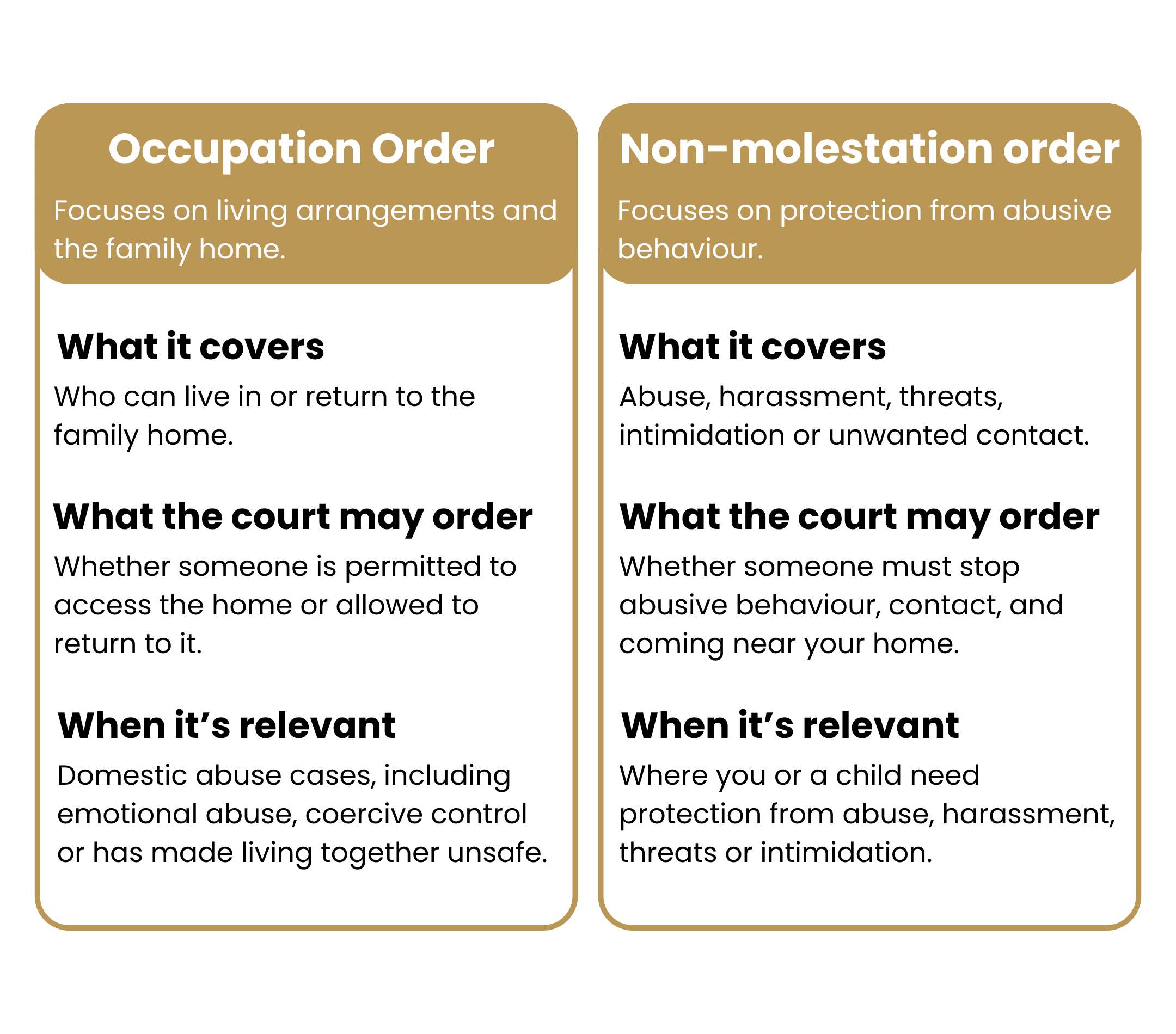
Both orders are types of injunction and applications are usually made using Form FL401. A solicitor can explain which order may be appropriate, whether an urgent without-notice application should be considered and what information the court may need.
Other protective options may also be available, depending on the circumstances. Domestic Abuse Protection Order, often called a DAPO, can include restrictions or requirements intended to prevent further domestic abuse
Who can apply for an occupation order?
You may be able to apply if you are experiencing domestic abuse and have a legal connection to the home or to the other person. This can include people who own or rent the home, are married or in a civil partnership with the owner or tenant, or currently live or previously lived with the other person.
The rules can also apply to former spouses, former civil partners, cohabitants, former cohabitants, certain family members and parents of the same child. Whether an occupation order is available will depend on the relationship, the housing arrangements and the legal basis for the application.
You do not necessarily have to have left the home before applying for an occupation order. If you have left because you felt unsafe, an occupation order may still be able to address whether you can return or whether the other person should be excluded.
How does the court decide?
The court considers the circumstances of each case carefully, looking at housing needs, financial resources, the likely effect of an order on each person and any children, and the parties’ conduct towards each other.
In some cases, the court applies the balance-of-harm test. Put simply, it considers whether you or a relevant child are likely to suffer significant harm because of the other person’s conduct if the order isn’t made. It then compares that with the harm the other person or a child may experience if the order is made.
This doesn’t mean that physical abuse must have taken place. Occupation order emotional abuse concerns can be relevant where a pattern of controlling, coercive, intimidating or psychologically harmful behaviour has made it unsafe or unreasonable to continue living together. The court will consider the overall situation and the information available.
How to get an occupation order
The application is normally made to the family court using Form FL401, providing with it, a supporting witness statement explaining what has happened, why you need the order and what you are asking the court to decide.
You don’t need to manage the process alone. Our solicitors can help you prepare the application and supporting statement clearly, assess whether an urgent or without-notice application may be appropriate and advise on whether to apply for a non-molestation order at the same time. We can also explain what information the court is likely to consider and represent you if court proceedings have started.
Emergency occupation orders and without-notice applications
In urgent cases, the court may consider a without-notice application, meaning the other party is not notified beforehand. This approach is only used if giving notice risks significant harm, could defeat the purpose of the application, or causes serious prejudice through delay.
If a without-notice order is granted, the respondent will have the chance to respond at a later return hearing, where the court will decide whether to maintain the terms.
While breaching an occupation order is not automatically a criminal offence, the court can attach a power of arrest to specific provisions. This allows the police to arrest an individual immediately if there is reasonable cause to believe a breach has occurred.
If you are in immediate danger, always call 999 before seeking legal advice.

How long does an occupation order last?

An occupation order is usually a temporary measure. Its duration will depend on the legal basis of the application, the circumstances of the case and the terms the court considers appropriate.
For some orders, the court may set a defined period and may have power to extend it. A solicitor can explain what may be realistic in your circumstances and whether further family law steps may be needed to deal with longer-term housing arrangements.
Court fees and legal aid for occupation orders
There is no court fee when applying for an occupation order.
Legal aid may be available for advice and representation in occupation order proceedings. These applications are means and merits tested, so the Legal Aid Agency will consider your financial circumstances and whether the application meets the relevant legal test.
However, the domestic abuse upper-eligibility waiver applies to applications for an order protecting someone from domestic abuse or forced marriage. This means the usual upper limits for income, savings and property can be waived for the protective injunction proceedings though you may still need to pay a contribution towards legal costs.
It’s important to note that the waiver does not automatically cover separate proceedings, such as an application about child arrangements. A solicitor can assess whether legal aid may be available for each part of your case and explain what financial information or evidence is needed. Read more about legal aid.
How National Legal Service can help
The seriousness of occupation orders makes experienced, clear and accurate legal guidance particularly important. We have assembled an accomplished, highly respected team of family law solicitors to help with these types of cases. In addition to this expertise, we are a national company with a regional focus across the UK, ensuring that we are there to support our clients every step of the way.
We can help with occupation order applications, non-molestation orders, legal aid assessments and related child arrangements concerns. Where court proceedings have started, a solicitor can prepare the necessary documents and represent you through the process.
Our role is to ensure your family remains safe and secure, whether by keeping occupancy of a property or barring individuals who pose a threat from the property. We will work closely with you to achieve a positive result.

Speak to a member of our legal team for specialist advice
We are always happy to talk to new clients about their needs in a one-to-one conversation. If you’re considering the need for an occupation order, speak to us to find out how we can help.
Occupation Orders FAQs
- Can I still get an occupation order if I don’t own the home?
Yes, you may still be able to apply even if you don’t own or rent the property but the rules depend on your relationship with the other person, whether the home was shared and the legal basis for the application.
For example, different rules may apply if you’re married, in a civil partnership or have lived with the other person as a couple. A solicitor can explain whether you may be eligible to apply.
- Can an occupation order remove someone from the home?
An occupation order can require a person to leave the home or exclude them from all or part of it. It can also restrict them from entering a defined area around the property where the court considers this appropriate.
The court considers the circumstances carefully, including the balance of harm, housing needs, finances, safety and the welfare of any children.
- Do I have to leave the home before applying?
No. You don’t have to leave the home before applying for an occupation order. If you have already left because of domestic abuse or safety concerns, the court may still consider whether you should be able to return or whether the other person should be excluded.
The right approach however, depends on the facts of the case. Taking legal advice can help you understand the options without making assumptions about what the court will decide.
- What happens if an occupation order is breached?
A breach of an occupation order is not automatically a criminal offence. However, the court can attach a power of arrest to certain provisions, which may allow police action if the order is breached. If you believe an order has been breached and there is immediate risk, call 999. Our solicitors can also advise on the appropriate legal steps.