Divorce Solicitors across England
Private and legal aid divorce support across England, including financial settlements and child arrangements. Legal aid may be available for qualifying cases.

Divorce Solicitors
Divorce usually involves legal, financial and practical decisions to be made at a very difficult time. National Legal Service Solicitors provides private and legal aid divorce support across England, including advice on no-fault divorce, financial settlements and child arrangements.
Legal aid may be available for qualifying divorce cases, particularly where domestic abuse or safeguarding concerns are involved. Our divorce solicitors can explain whether your case may fall within scope, what information is likely to be needed and what funding options may be available.
NLS advises on both uncontested divorce and divorce cases where related issues are disputed. Although the divorce application itself is now usually more straightforward due to the introduction of no-fault divorce, disagreements about finances, property, pensions or children may still need careful negotiation and legal advice.
If you need advice about divorce, separation or the practical arrangements that follow, you can contact NLS for free initial advice through a no-obligation consultation.
What does a divorce solicitor do?

A divorce solicitor helps you understand the legal process for ending a marriage and the decisions that may need to be made alongside it. This can include preparing or responding to a divorce application, advising on financial arrangements, helping with child arrangements and representing you in court proceedings where needed.
The right level of support will depend on your circumstances. Some people need advice on a straightforward divorce application, while others need help with domestic abuse, complex finances, children’s arrangements or urgent decisions about the family home.
A divorce solicitor can help with:
- Explaining the no-fault divorce process
- Preparing or reviewing divorce application documents
- Advising on financial settlements
- Helping with arrangements for children
- Explaining whether legal aid may be available
- Advising where domestic abuse or coercive control is a concern
- Negotiating with the other party or their solicitor
- Preparing court applications where agreement cannot be reached
- Advising on separation agreements where divorce is not yet being pursued
Divorce and separation can feel uncertain, especially if communication with your former partner is difficult. A solicitor can help you understand the process step by step and avoid making decisions without knowing the legal effect.
Speak to a member of our legal team for specialist divorce and separation advice
In a very limited set of circumstances, legal aid may be available to those seeking to petition for divorce or the dissolution of a civil partnership. We can advise on this during your initial meeting with us.
If you’re going through a separation and wish to appoint divorce solicitors to look after your best interests and help you navigate what is an extremely stressful time, contact the National Legal Service on 0203 601 5051.
Looking to learn more? Read our complete guide to Divorce here.
Divorce Specialisms
Divorce can involve more than ending the marriage itself. You may also need advice about finances, property, safety, separation arrangements or related family law issues before deciding what steps to take.
Our divorce solicitors can explain the options available and help you understand the process in clear, practical terms. The right approach will depend on your circumstances and whether legal aid may be available.
Financial Settlement
A financial settlement helps resolve how money, property, pensions, debts and other assets are dealt with during divorce. Our solicitors can advise on financial disclosure, negotiation and court applications where an agreement cannot be reached.

Forced Marriages
If you are at risk of forced marriage or need advice after a forced marriage, our solicitors can explain the legal protections that may be available. This may include urgent advice on safety, family law options and applications for protective orders where appropriate.

Separation Agreement
A separation agreement can help record practical arrangements when a couple separates but does not divorce straight away. Our solicitors can advise on what the agreement may cover, including finances, property and responsibilities during separation.

Legal aid for divorce - do you qualify?
Legal aid may be available for some divorce and family law cases, but it is not available for every divorce. In many private family law matters, eligibility depends on the type of case, your financial circumstances and whether the case meets the relevant legal aid criteria.
Where domestic abuse is involved, legal aid may be available for advice about divorce, finances or children if the legal aid rules are met. GOV.UK explains that legal aid may be available where there is evidence that you or your children have experienced domestic abuse and you cannot afford legal costs.
NLS holds a legal aid franchise with the Legal Aid Agency and can explain whether your divorce or related family law matter may qualify. If legal aid is not available, our team can discuss private funding options before you decide how to proceed.
What does legal aid cover in divorce cases?
Legal aid for divorce-related matters usually depends on the issue that needs advice. A divorce application on its own may not always qualify, but related issues such as domestic abuse, child arrangements or financial matters may be within scope in some circumstances.
Legal aid may be relevant where you need advice about:
- Divorce or separation after domestic abuse
- Financial arrangements where domestic abuse is a factor
- Child arrangements where there is evidence of domestic abuse or child abuse
- Protective injunctions such as non-molestation orders
- Occupation orders relating to the family home
- Urgent family law applications linked to safety or safeguarding
If you are unsure whether you qualify, it is better to ask before assuming you cannot get help. Legal aid rules can be detailed and a solicitor can explain what evidence and financial information may be needed.
What are the means and merits tests?
The means test looks at your financial circumstances. This can include income, savings, benefits, housing costs and other relevant financial information.
The merits test looks at whether the case meets the legal aid criteria. This may include whether there is a legal basis for the work, whether the proposed steps are proportionate and whether legal aid funding is justified under the rules.
Some domestic abuse protection applications may be subject to different legal aid financial rules. This does not mean every person will automatically qualify, so it is important to speak to a legal aid divorce solicitor before relying on this.

No-fault divorce - what changed?
No-fault divorce has been available in England and Wales since 6 April 2022 under the Divorce, Dissolution and Separation Act 2020. The change removed the need to blame the other person or rely on a period of separation before applying for divorce.
The application is now based on a statement that the marriage has irretrievably broken down. This means the focus of many cases can move away from proving blame and towards resolving the practical issues that follow separation, such as finances, property and arrangements for children.
Can a divorce still be contested?
The divorce application itself is now much harder to dispute than under the previous system. In most cases, the more difficult disputes are about financial arrangements, the family home, pensions, business assets or child arrangements rather than whether the divorce should happen.
There may still be situations where legal advice is needed urgently. For example, a respondent may need advice about jurisdiction, procedural concerns, finances or related family law issues before taking the next step.
NLS can advise on both uncontested divorce and cases that people may commonly describe as contested. A solicitor can help you understand what needs to be dealt with through the divorce process and what may need a separate court application.
How long does a divorce take?
GOV.UK states that divorce normally takes at least 7 months. This is because the process includes mandatory waiting periods before the divorce can be finalised.
The time needed to resolve finances or child arrangements can be different from the divorce timetable. Some issues may be agreed before the divorce is finalised, while others can take longer if there is disagreement, missing information or court proceedings are needed.
Sorting out finances on divorce
A divorce ends the marriage, but it does not automatically resolve financial claims between spouses. Financial settlement advice can help you understand how property, savings, pensions, income, debts and other assets may be addressed.
A financial settlement can be agreed between the parties or decided by the court if agreement cannot be reached. Even where the divorce is amicable, it is usually sensible to get legal advice before relying on informal arrangements.
Financial settlement issues may include:
- The family home
- Savings and investments
- Pensions
- Debts
- Business interests
- Spousal maintenance
- Income needs
- Child maintenance
- Personal belongings or vehicles
- Future financial responsibilities
A solicitor can explain what financial disclosure may be needed and how the court may approach fairness. This will depend on the circumstances, including the length of the marriage, each person’s needs, financial resources and any children involved.
What happens to the house when you divorce?
What happens to the family home depends on the overall financial circumstances. The home may be sold, transferred, retained by one person or dealt with in another way as part of a wider financial settlement.
The court can consider housing needs, children’s needs, mortgage affordability, ownership and other financial resources. It is important to get advice before leaving the property, agreeing to a sale or signing documents that may affect your position.
Children and divorce
Divorce and child arrangements are legally separate issues, but they often need to be considered at the same time. Parents may need to agree where children live, how much time they spend with each parent and how important decisions will be made after separation.
If agreement is possible, arrangements may be recorded informally or through a more structured process. Where agreement cannot be reached, a solicitor can explain the options available and what the court may consider if an application becomes necessary.
The court’s focus in child arrangements cases is the child’s welfare. This means decisions are not based on either parent “winning” but on what arrangements are considered best for the child in the circumstances.
A divorce solicitor can advise on child arrangements alongside the divorce process. If there are safeguarding concerns, domestic abuse or difficulties with communication, getting advice early can help you understand the safest and most appropriate next steps.
Read more about child arrangements
Divorce where domestic abuse is involved
Domestic abuse can affect the divorce process, financial negotiations and arrangements for children. Abuse may include physical abuse, emotional abuse, coercive control, financial abuse, harassment, threats or controlling behaviour.
If you are in immediate danger, call the police or seek urgent support. If it is safe to do so, a solicitor can explain legal options such as non-molestation orders, occupation orders, child arrangements advice and legal aid where available.
Domestic abuse can also affect how communication is handled during divorce. In some cases, direct negotiation may not be safe or appropriate and a solicitor can help consider safer ways to manage correspondence and applications.

Separation agreements
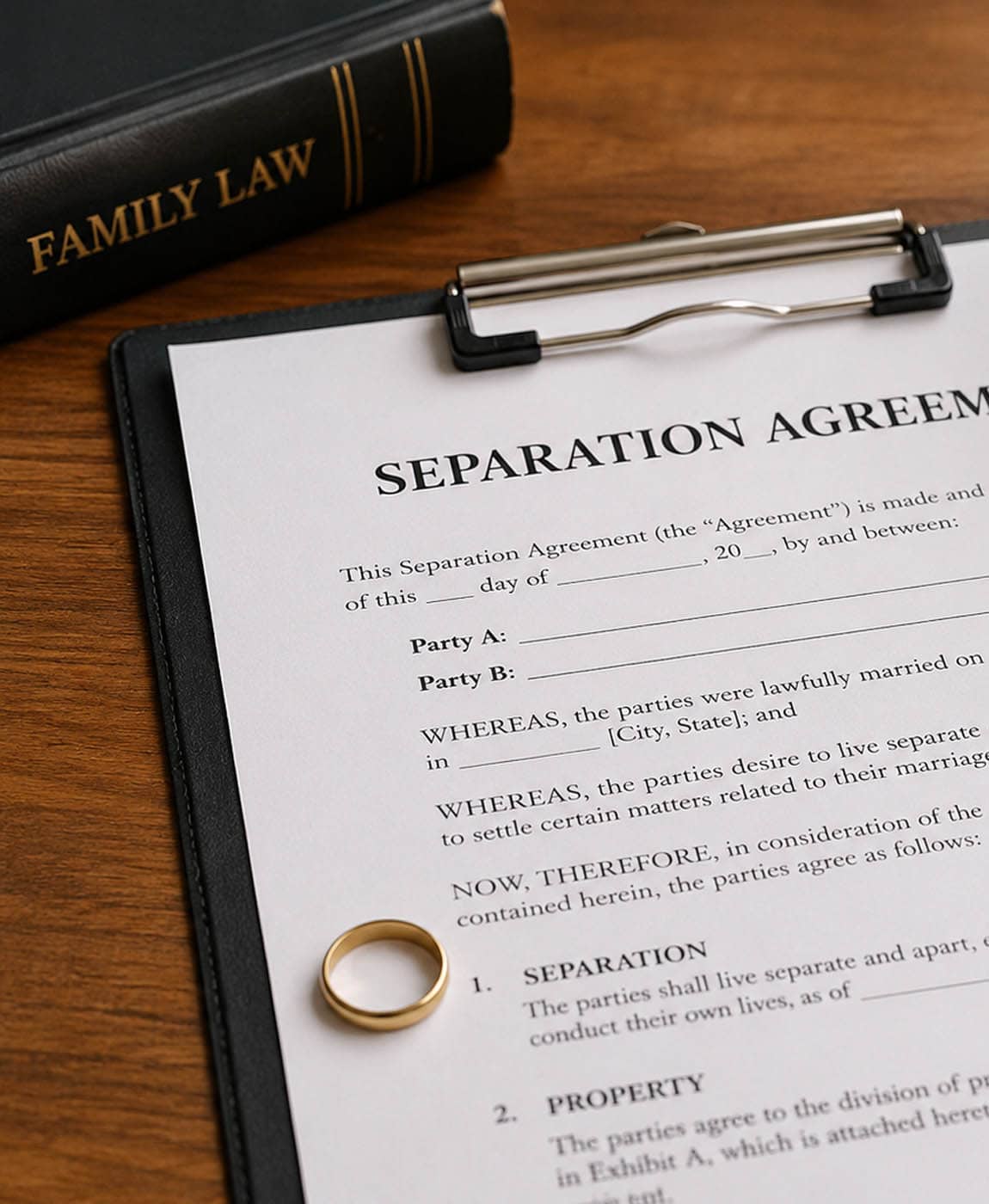
A separation agreement can help record arrangements when a couple separates but does not divorce immediately. This may be relevant where there are financial issues to manage, property responsibilities to clarify or practical arrangements to set out.
A separation agreement can cover matters such as who pays certain bills, what happens to the home, how savings or debts are treated and what arrangements are intended while the couple remains married. It does not end the marriage, but it can help provide structure during separation.
Legal advice is important before entering into a separation agreement. A solicitor can explain what the agreement can and cannot do and how it may be considered if divorce or financial proceedings happen later.
Divorce solicitors across England
NLS supports clients through offices across England, not only in London. If you are looking for divorce solicitors near you, you can contact the office most convenient for you or ask whether a phone or video appointment may be suitable.
Our divorce solicitors advise on no-fault divorce, financial settlements, child arrangements, domestic abuse and legal aid where available. The right approach will depend on your circumstances, whether the divorce is agreed and whether any urgent protective steps are needed.
Speak to a divorce solicitor
If you are considering divorce or have received divorce papers, early advice can help you understand the process and avoid missing important steps. You do not need to have all documents prepared before making contact.
National Legal Service Solicitors offers free initial advice through a no-obligation consultation. Legal aid may be available for qualifying cases and our team can explain your options clearly before you decide how to proceed.
Call 020 3601 5051 or request a callback to speak to a divorce solicitor.
Divorce Solicitors FAQs
- How much does a divorce solicitor cost?
The cost of a divorce solicitor depends on the work needed, whether the divorce is agreed and whether there are linked issues such as finances, property or child arrangements. A straightforward advice appointment will usually involve less work than a case involving contested financial matters or court proceedings.
Legal aid may be available for qualifying divorce and family law cases, particularly where domestic abuse or safeguarding concerns are involved. A solicitor can explain likely costs, funding options and whether legal aid may be available.
- Can I get legal aid for divorce?
You may be able to get legal aid for some divorce-related matters, but it is not available for every divorce. GOV.UK explains that legal aid may be available for advice on finances, children or divorce where someone has been in an abusive relationship and meets the relevant rules.
Eligibility can depend on the type of issue, your financial circumstances, evidence of domestic abuse and the merits of the case. A legal aid divorce solicitor can assess this with you.
- What is no-fault divorce?
No-fault divorce means you do not need to prove blame or rely on a period of separation to apply for divorce. The application is based on a statement that the marriage has irretrievably broken down.
This system has applied in England and Wales since 6 April 2022 under the Divorce, Dissolution and Separation Act 2020. Financial settlements and child arrangements are still separate issues that may need legal advice.
- Do I need a solicitor to get divorced?
You do not always need a solicitor to submit a divorce application, especially if the divorce is straightforward and there are no wider issues. However, legal advice can be important if there are finances, property, pensions, children, domestic abuse or uncertainty about the process.
A solicitor can help you understand what the divorce does and does not deal with. This is particularly important because finalising the divorce does not automatically resolve financial claims.
- Can my solicitor deal with child arrangements during divorce?
Yes, a solicitor can advise on child arrangements alongside divorce. This can include where a child lives, how much time they spend with each parent and how decisions about the child are made.
Child arrangements are legally separate from the divorce itself, but they often need to be considered at the same time. If there are safeguarding concerns or domestic abuse, a solicitor can explain what options may be available.