What Is a DAPO (Domestic Abuse Protection Order)?
A Domestic Abuse Protection Order (DAPO) is a court order being piloted in particular areas in England and Wales. Introduced under the Domestic Abuse Act 2021, they are designed to provide protection for victims of domestic abuse. It enables the police, victims, or third parties to apply for a court order that can impose restrictions on an alleged abuser.

What is a Domestic Abuse Protection Order?
A DAPO is a flexible protective order introduced under Part 3 of the Domestic Abuse Act 2021. The court can make an order where it considers this necessary to protect a person from domestic abuse or the risk of domestic abuse.
Unlike Non-Molestation Orders or Occupation Orders, DAPOs have been specifically designed to be more flexible and are designed to work both at early stages and in long-term safety planning. It can be made in different types of court proceedings, including family, civil and criminal proceedings. Depending on the circumstances, a DAPO may include:
- Restrictions on contact or approaching a home, workplace or other location
- A requirement to tell the police about a name or address and any changes
- Electronic monitoring
- A requirement to attend a behaviour-change programme or another suitable intervention
There is no minimum or maximum duration for a DAPO. The court will decide how long the order should last based on the protection needed in the individual case.
What is the difference between a DAPN and a DAPO?
A Domestic Abuse Protection Notice, known as a DAPN, is a short-term notice issued by the police. It can provide immediate restrictions while the police apply to the magistrates’ court for a DAPO.
A DAPO is the court order that may follow. It can provide protection for a longer period and include a wider range of restrictions or requirements. A DAPN can last for up to 48 hours and the related DAPO application must usually be heard within that period.
| DAPN | DAPO | |
|---|---|---|
| Made by |
The police |
A court |
| Purpose |
Short-term protection |
Longer-term protection where needed |
| How long it lasts |
Up to 48 hours |
The court sets the duration |
| What it can include |
Restrictions on behaviour |
Restrictions and positive requirements |
You don’t need to decide which route applies before seeking help. The police and the court will consider the circumstances and a solicitor can explain the options that may be available.
Where are DAPOs available?
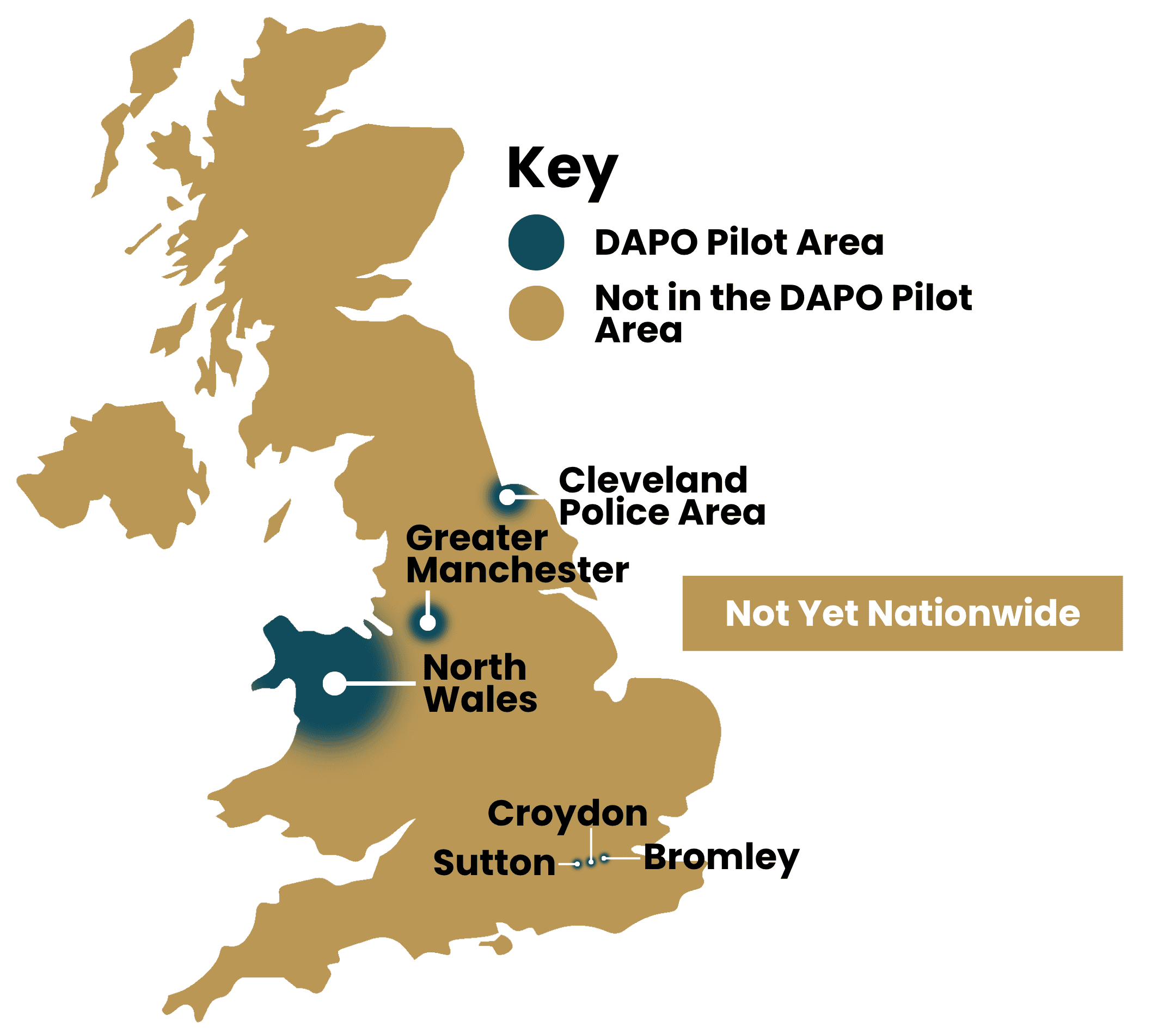
DAPOs are currently available only in pilot areas. As of September 2026, the pilot includes Greater Manchester, the London boroughs of Croydon, Bromley and Sutton, areas covered by Cleveland Police, North Wales and the British Transport Police. The pilot is scheduled to continue until at least November 2026, so this position should be checked again before publication.
Availability depends on where the alleged abuser lives, rather than where the person seeking protection lives. This means a DAPO application may still be possible if you live outside a pilot area but the alleged abuser lives within one. If their location is unknown, the police or court can help establish whether the DAPO route is available.
Pilot locations include:
- Greater Manchester
- Croydon, Bromley and Sutton
- Cleveland Police area
- North Wales
- Cases involving the British Transport Police
If a DAPO is not available, this does not mean that there is no legal protection. A non-molestation order or occupation order may be available through the Family Court and may be more suitable for your circumstances.
How can you apply for a DAPO?
You can report domestic abuse to the police and ask them to consider issuing a Domestic Abuse Protection Notice or applying for a DAPO. Where the DAPO scheme is available, you may also be able to apply directly to the Family Court using Form DA1 and a supporting witness statement.
A DAPO can also be made during existing family, civil or criminal proceedings. In some circumstances, a third party, such as a family member, friend or professional, may apply with the court’s permission. A criminal conviction is not required.
Our domestic abuse solicitors can explain whether a DAPO is available, help you understand the court process and advise on other protective orders where it is not. If it’s not safe to contact the other person or gather information, do not take steps that could increase the risk to you or your children.
What happens if a DAPO is breached?
A DAPO is legally binding. Breaching its conditions, whether by doing something the order prohibits or failing to do something it requires without a reasonable excuse, is a criminal offence with a penalty of up to five years’ imprisonment, a fine or both. This can be reported to the police.
If you or someone else is in immediate danger, call 999. A breach should be taken seriously, but an order cannot guarantee safety, so practical safety planning and appropriate support remain important.
What protection is available if a DAPO isn’t?
Because the DAPO is limited to pilot areas, many people seeking protection from domestic abuse will not currently be able to use this scheme but it doesn’t stop you seeking help. Other court orders may still be available and can be applied for across England and Wales.
A solicitor can explain which route is appropriate based on the relationship, the risks involved and whether there are concerns about the family home or child arrangements.

| Order | What it can address |
|---|---|
| DAPO |
Restrictions and requirements to protect against domestic abuse where the pilot scheme is available |
| Non-molestation order |
Abuse, threats, harassment, intimidation and unwanted contact |
| Occupation order |
Who can live in or enter the family home |
A non-molestation order may be appropriate where you or a child need protection from abuse, threats, harassment or intimidation. An occupation order may be relevant where there are concerns about who should remain in the family home or whether someone should be excluded from it.
Legal aid for DAPOs
There is no court fee for a person seeking a DAPO. Legal aid may be available to cover legal advice and representation for a DAPO application, although eligibility is subject to means and merits tests.
The funding position can depend on the route being used and whether other family law proceedings are also involved. If you are concerned about the cost of taking action, you don’t have to navigate the process alone. Our team is here to provide clear, compassionate advice, help you understand your options and support you in taking the next steps with confidence.
How National Legal Service can help
Understanding whether a DAPO is available can be difficult because the scheme is new and limited to selected areas. National Legal Service Solicitors can provide clear advice about the DAPO process where it is legally available and discuss the protective orders that may be more suitable where it is not.
We can advise on DAPOs, non-molestation orders, occupation orders, legal aid and related child arrangements concerns. Where court proceedings have started, a solicitor can explain the process, prepare relevant documents and represent you where appropriate.
Call 020 4654 8174 or complete our contact form to request a confidential callback. If you contact us outside office hours, you can use the contact form to request a callback.
Information is for general guidance in England and Wales and is not a substitute for legal advice.

Request Callback
We know that no two cases are ever the same and we are dedicated to guiding you through the legal process with tailored solutions which work for you. For free initial legal advice please fill out the form below.
Frequently asked questions about DAPOs
- Can I apply for a DAPO myself?
You may be able to apply directly to the Family Court using Form DA1 if the DAPO scheme is available in the relevant pilot area. You can also ask the police to consider applying on your behalf.
Whether a direct application is possible will depend on the circumstances and the pilot arrangements. A solicitor can explain the available route and whether another protective order may be more appropriate.
- Is a DAPO available everywhere?
No. DAPOs are currently being piloted in selected areas and are not available nationwide. The key factor is usually whether the person alleged to have carried out the abuse lives in a pilot area.
If a DAPO is not available, you may still be able to apply for a non-molestation order or occupation order through the Family Court.
- Is a DAPO different from a non-molestation order?
Yes. A DAPO is a newer, flexible order that can include both restrictions and positive requirements. A non-molestation order focuses on protecting someone or a child from abuse, threats, harassment and intimidation.
Both orders can be important forms of legal protection. The most suitable option depends on the facts of the case and the orders legally available in your area.
- What happens if someone breaches a DAPO?
Breaching a DAPO is a criminal offence. You should report a breach to the police and call 999 if there is immediate danger.
The police will investigate the report and decide what action to take. Keep any information about the breach where safe to do so, but do not put yourself at risk to collect evidence.