
To change a child’s surname, you generally need written agreement from everyone with parental responsibility or an order from the Family Court. A deed poll can record the change, but it doesn’t replace the need for consent or a court order if a parent objects.
Changing a child’s surname can feel particularly important after separation or where family circumstances have changed. However, because a surname is a significant part of a child’s identity, the law requires careful consideration of the child’s welfare.
Whose consent do you need to change a child’s surname?
You usually need the agreement of everyone with parental responsibility before changing a child’s surname. Parental responsibility includes the legal rights, duties, and responsibilities involved in caring for a child, including agreeing to a name change.
Because a parent or guardian may not live with the child or communicate with them regularly, you can’t assume one parent can change the child’s surname alone just because the child lives mainly with them.
Where a child arrangements order states who the child lives with, section 13 of the Children Act 1989 is particularly clear. No one can cause the child to be known by a new surname without the written consent of everyone with parental responsibility or permission from the court.
Changing a child’s surname by deed poll
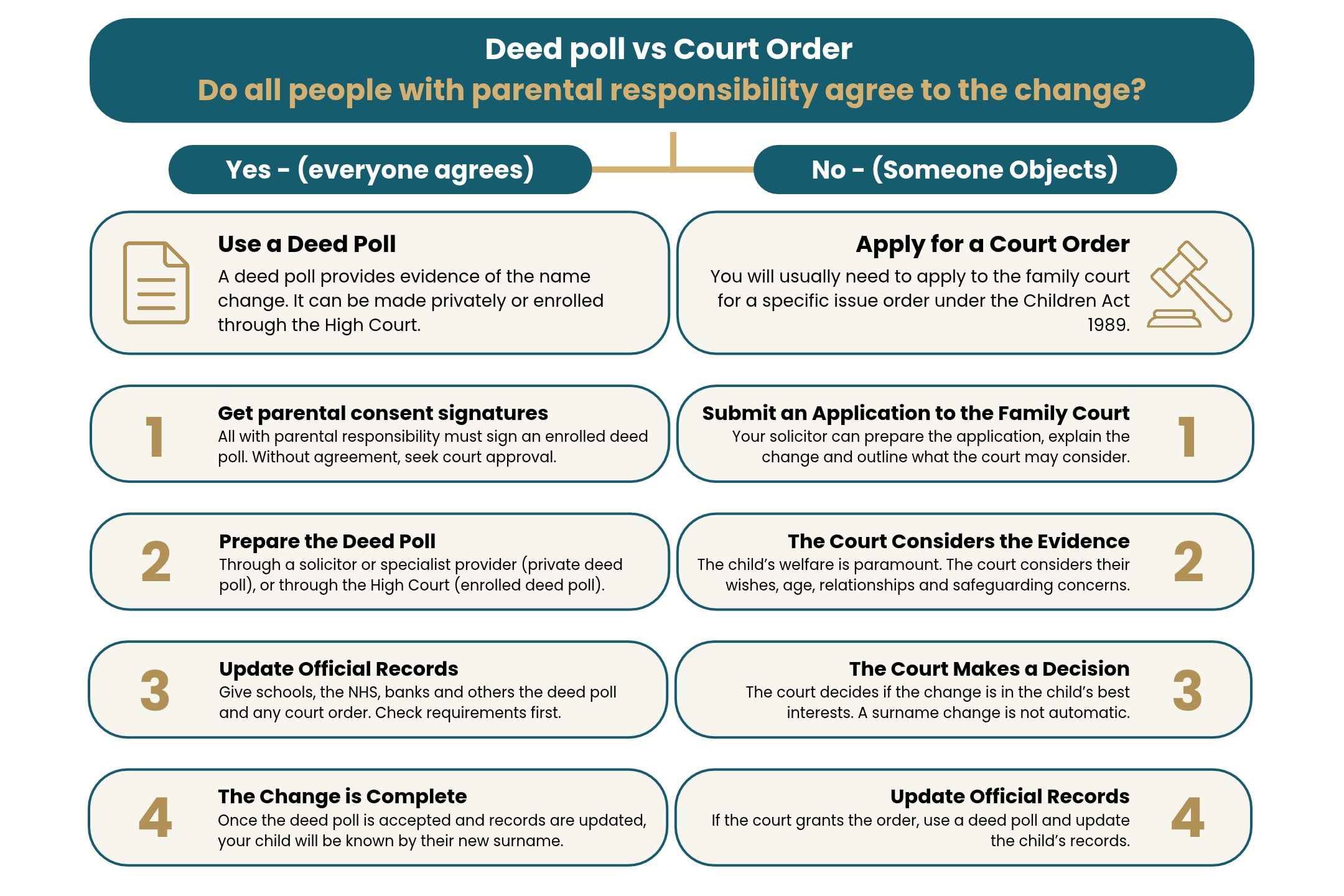
A deed poll is a legal document that provides evidence of a name change. For a child under 18, you can make it privately through a solicitor or specialist provider, or enrol it with the High Court so the change is placed on the public record.
An enrolled deed poll is not always necessary. However, some organisations may require specific evidence before updating their records, so it is worth checking their requirements before deciding which route to use.
For an enrolled child deed poll, everyone with parental responsibility must sign. If one person does not agree to sign, the other must apply for a court order before the enrolled deed poll can proceed.
Changing a child’s surname by deed poll does not resolve a disagreement between parents. If consent is disputed, a court order is usually required before you can make the change or rely on it with official organisations.
Can I change my child’s surname without the father’s or mother’s consent?
Generally, no. If the other parent has parental responsibility and does not agree to the change, you will usually need the Family Court to decide the issue.
This applies equally to mothers, fathers and anyone else who holds parental responsibility. The key question is not whether the person has contact with the child or pays maintenance, but whether they have parental responsibility and whether they agree to the proposed change.
Circumstances can be more complex, including when a person cannot be found or when there are serious safeguarding concerns. If domestic abuse is relevant, avoid contacting the other person in a way that could increase risk to you or your child.
What happens if the other parent objects?
If agreement cannot be reached, you can ask the Family Court to decide whether the child’s surname should be changed. This is normally done by applying for a specific issue order under the Children Act 1989. A specific issue order lets the court decide a particular aspect of a child’s upbringing when those with parental responsibility cannot agree. In this situation, the court would decide whether the child should be known by the proposed new surname.
A solicitor can help you prepare the application, set out the reasons for the proposed change and explain what information the court is likely to consider.
How does the court decide whether to change a child’s surname?
The court’s paramount consideration is the child’s welfare. This means the court focuses on what is best for the child, rather than on either parent’s preference.
The courts treat a change of surname as a serious step and are often slow to approve one. Case law confirms that a change should not be made lightly, and the court must be satisfied that changing the surname would be better for the child than keeping their current name.
Changing a child’s surname is therefore unlikely to be approved simply because one parent has remarried, wants the child to share their surname or believes a new name would be more convenient. The court will consider the child’s identity, relationships and the likely effect of the change now and in the future.
Relevant factors may include:
- The child’s age, wishes and understanding
- Their relationship with each parent and wider family
- How long they have used their current surname
- Whether the name change would affect their sense of identity
- Any practical benefits or difficulties linked to the proposed change
- The reasons each person gives for supporting or opposing it
- Any domestic abuse, safeguarding or welfare concerns
A change of surname is not automatic, even when family circumstances have changed significantly, so the court considers the evidence in each case.
How National Legal Service Solicitors can help
Disagreements about a child’s surname can be emotionally difficult, particularly if communication between parents has broken down. Understanding the consent rules and the court process can help you take a considered next step.
National Legal Service Solicitors can advise on parental responsibility, child arrangements, specific issue orders and prohibited steps orders. We can explain whether consent is needed, help with a court application where agreement is not possible and represent you if court proceedings have started.