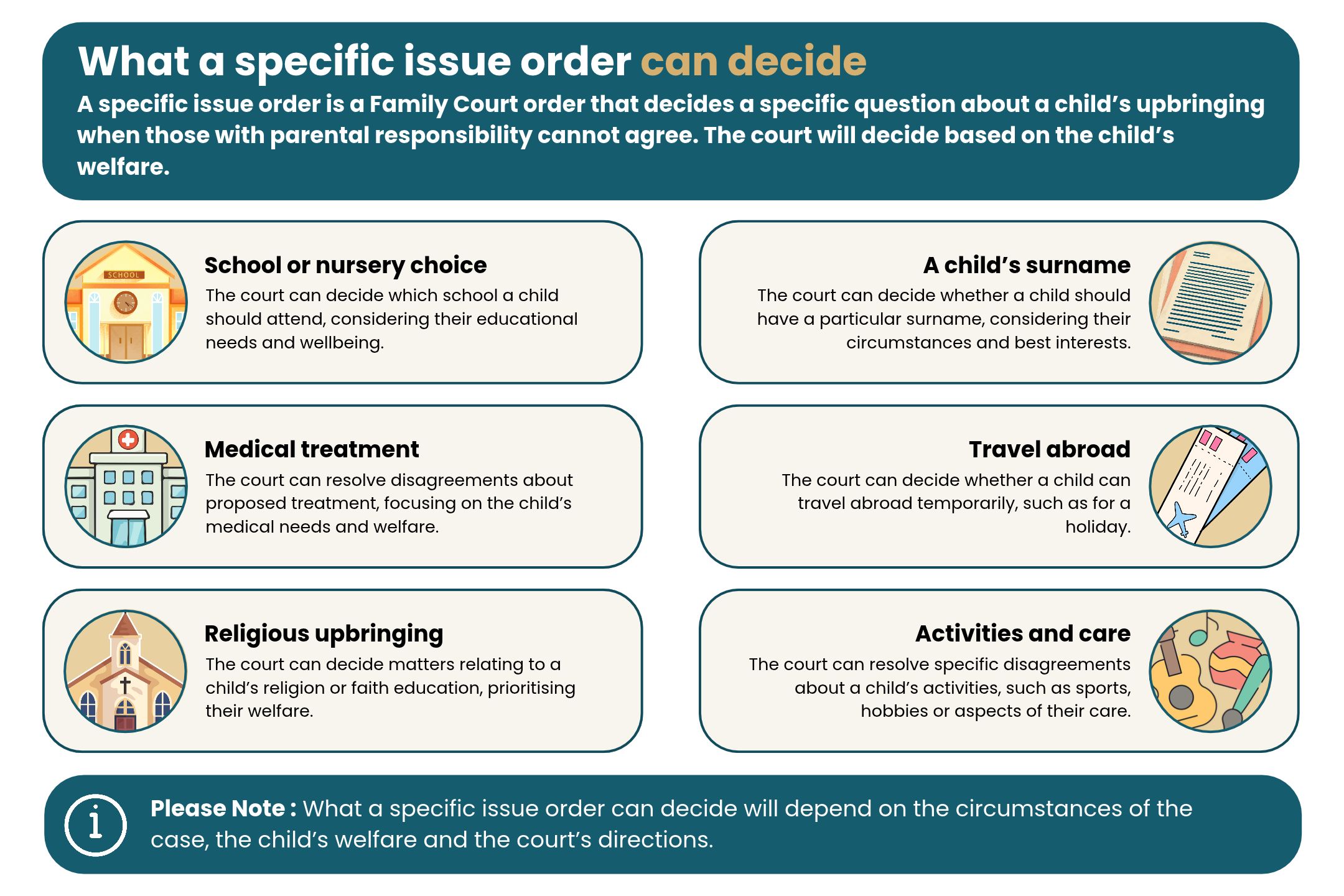
A specific issue order is a Family Court order that decides one particular question about a child’s upbringing when those with parental responsibility cannot agree. It may be used for disputes about schooling, medical treatment, religion, a child’s surname or temporary travel abroad. The court will decide based on the child’s welfare.
Disagreements about an important decision can feel difficult, especially where communication between parents has broken down. Understanding the court process can help you decide whether a specific issue order may be appropriate and what information the court is likely to consider.
What can a specific issue order decide?
A specific issue order is made under section 8 of the Children Act 1989. It gives the court the power to decide a particular question that has arisen, or may arise, in connection with an aspect of parental responsibility for a child.
The order is intended to resolve a defined disagreement rather than make arrangements about every part of a child’s life. For example, the court may decide whether a child should attend a particular school or whether they can travel abroad for a holiday.
A specific issue order may be used to decide questions about matters such as:
- A child’s school or nursery placement
- Medical treatment
- Religious upbringing
- A proposed change to a child’s surname
- Temporary travel abroad
- A particular activity or aspect of a child’s care
The circumstances of each case will determine whether an application is appropriate and what decision the court may need to make. The court will consider whether an order is necessary and whether the issue can be decided in a way that supports the child’s welfare.
Who can apply for a specific issue order?
Parents, guardians, special guardians and people with parental responsibility can usually apply for a specific issue order. A person named in a child arrangements order as someone the child lives with may also be entitled to apply.
Other people may still be able to apply, but they may need the court’s permission first. This can apply to a wider family member or another person who has an important role in the child’s life but does not have parental responsibility.
The court will consider the person’s connection to the child, the nature of the proposed application and the likely effect on the child. Our solicitors can explain whether you can apply directly or whether you may need court permission.
How do you apply for a specific issue order?
An application is generally made to the Family Court using Form C100. The same form that is used for child arrangements orders, prohibited steps orders and applications to vary or discharge an existing section 8 order.
The application should explain the issue the court is being asked to decide, the reasons agreement has not been possible and the outcome you are asking the court to consider. It is important to keep the application focused on the child’s needs and avoid using it to revisit wider disagreements that are not relevant to the particular issue.
Before applying, you will usually need to attend a Mediation Information and Assessment Meeting, known as a MIAM. This meeting considers whether mediation or another form of dispute resolution is more suitable before court proceedings start, though a valid exemption may apply where there are domestic abuse concerns, child protection concerns or urgency.
In urgent cases, the court may be asked to deal with the application more quickly. Here, the court will consider the urgency and whether the other person should be given notice before it considers the application.
How does the court decide?
The court’s paramount consideration is the child’s welfare. In plain English, this means the court must focus on what is best for the child rather than what either parent prefers.
Where a specific issue order is opposed, the welfare checklist in the Children Act 1989 guides the court’s assessment of the child’s circumstances and needs.
Relevant factors may include:
- The child’s wishes and feelings, taking account of their age and understanding
- Their physical, emotional and educational needs
- The likely effect of any change in their circumstances
- Any harm they have suffered or may be at risk of suffering
- Each parent’s ability to meet their needs
- The range of orders available to the court
The court will assess the evidence available in the individual case. It may decide that an order is needed, make a different order from the one requested or decide that no order is necessary.
Specific issue order vs prohibited steps order
A specific issue order and a prohibited steps order are both section 8 orders. They often apply in similar situations but serve different purposes.
A specific issue order asks the court to make a positive decision about a defined question, whereas a prohibited steps order asks the court to prevent someone from taking a particular step without the court’s permission.
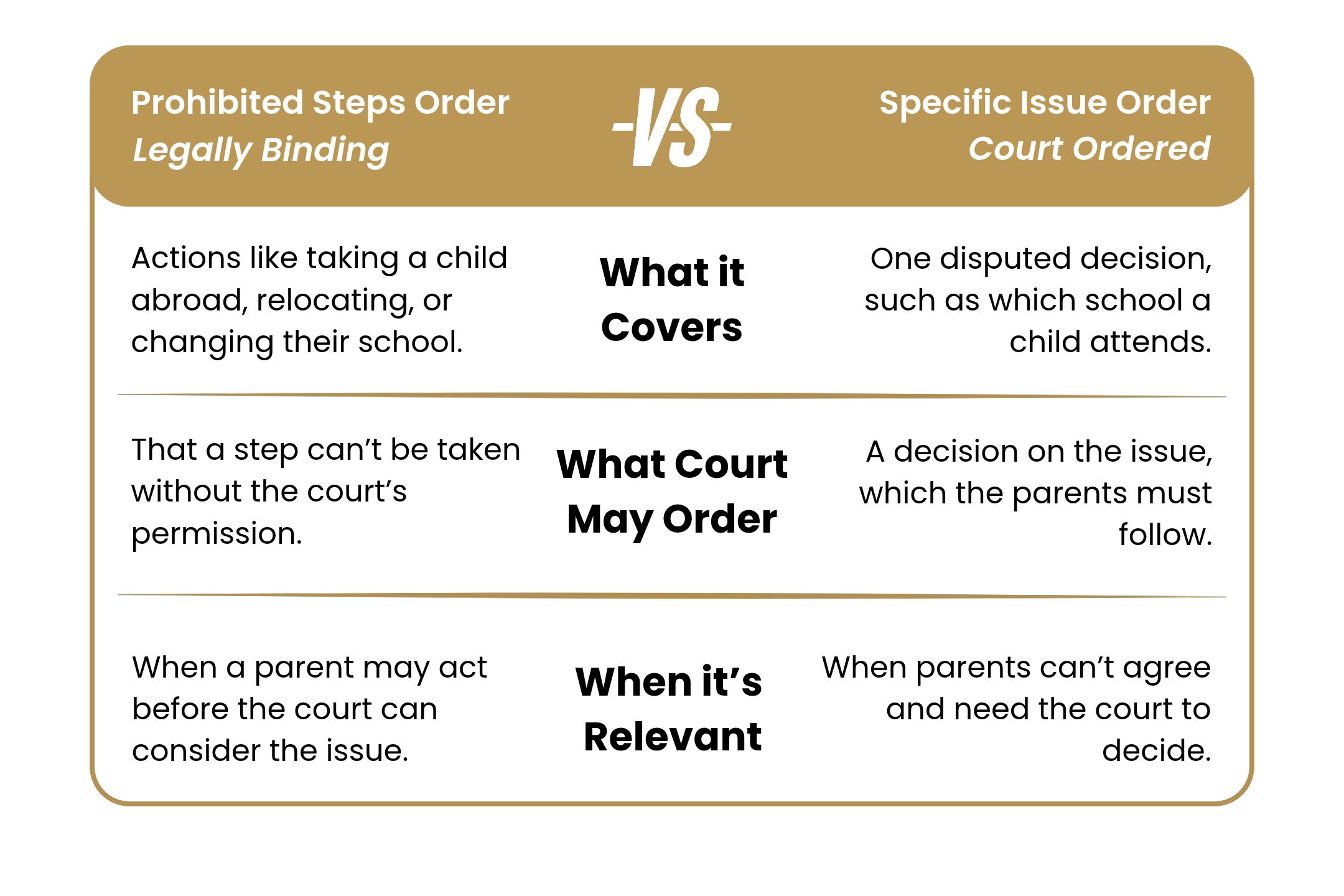
The right application depends on the problem that needs to be resolved. In some cases, both orders may be relevant. For example, one parent may seek an order to decide a question while also asking the court to prevent a decision being made before the case has been considered.
How long does a specific issue order last?
The duration of a specific issue order will depend on the nature of the issue the court has been asked to decide. If the matter concerns a one-off decision or a specific timeframe, the order may need to remain in force only for a short period. The duration is usually defined in any order that the court makes.
Where no fixed end date applies, a specific issue order will generally end when the child turns 16. The court can make an order that continues beyond that age, but this happens only in exceptional circumstances. Any order that does continue past a child’s 16th birthday cannot extend beyond their 18th birthday.
If circumstances change after an order has been made, it may be possible to apply to vary or discharge it. Until the court changes or ends the order, everyone bound by its terms is expected to comply with it.
Court fees and legal aid for specific issue orders
A court fee applies when applying for a specific issue order, although fee support may be available depending on your circumstances. The current Form C100 guidance directs applicants to check the applicable court fee and whether fee support is available.
Legal aid may be available for private law children proceedings where there is prescribed evidence of domestic abuse or child protection concerns. Eligibility will also depend on the relevant financial and merits tests.
You do not need to have all the evidence before speaking to a solicitor. However, you will usually need evidence before legal aid can be confirmed. This may include information from the police, court, a health professional, domestic abuse support service, MARAC or children’s services.
Get Advice on a Specific Issue Order
If an unresolved decision is affecting your child, early legal advice can help you understand whether a specific issue order is the right step and what the court process may involve.
National Legal Service can advise on specific issue orders, prohibited steps orders, child arrangements and legal aid. Contact us to discuss your situation in confidence.