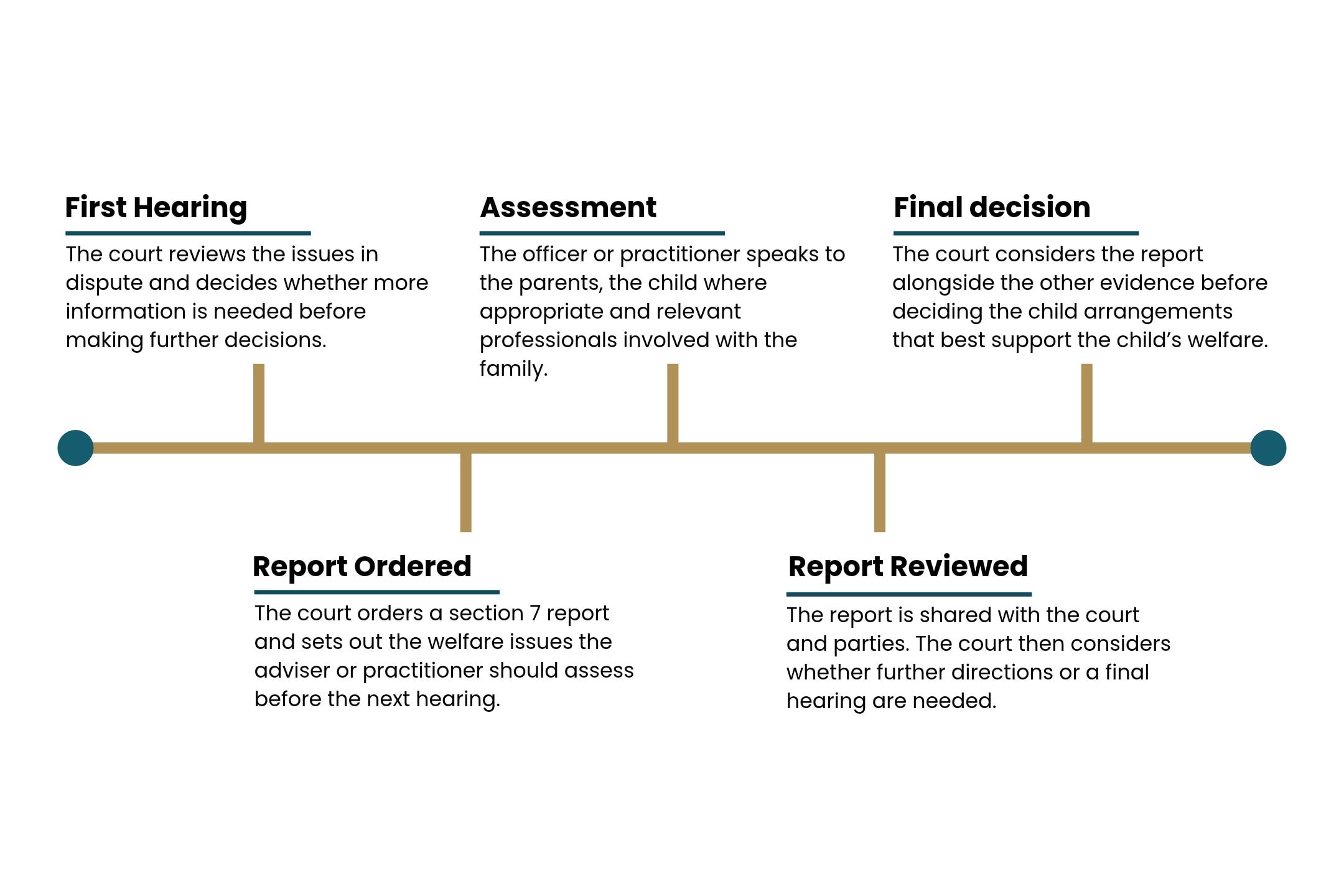
A section 7 report is a welfare report the Family Court orders when it needs more information before making a decision about a child. It is usually prepared by a Cafcass Family Court Adviser and may include recommendations about child arrangement orders.
If the court has ordered a report, it’s understandable to have questions about what it means for you and your child. Although the report doesn’t decide the case, it can provide important information to help the court consider which arrangements best support the child’s welfare.
Who writes a section 7 report and why is it ordered?
A section 7 report is ordered under section 7 of the Children Act 1989. The court can ask Cafcass (Children and Family Court Advisory and Support Service) or a local authority to prepare a report on matters relating to a child’s welfare that the court needs help understanding.
In most child arrangements cases, a Cafcass Family Court Adviser writes the report. However, if the family are already known to the local authority (formerly known as social services) they may be better placed to assess the issues the court has identified.
The court will usually make directions explaining what the report should cover. This may be because parents disagree about where a child should live, how much time the child spends with each parent, or another issue affecting the child’s upbringing. A section 7 report isn’t the same as a section 37 report, which the court orders when it is considering whether children’s services should investigate possible care or supervision proceedings. It is also different from the role of a children’s guardian, who may be appointed to represent a child in more complex cases.
If the court has ordered a Section 7 report, a solicitor can help you understand the process and prepare for the next steps. Our child care solicitors can explain your options and help you understand how the report may affect your case.
What does a section 7 report cover?
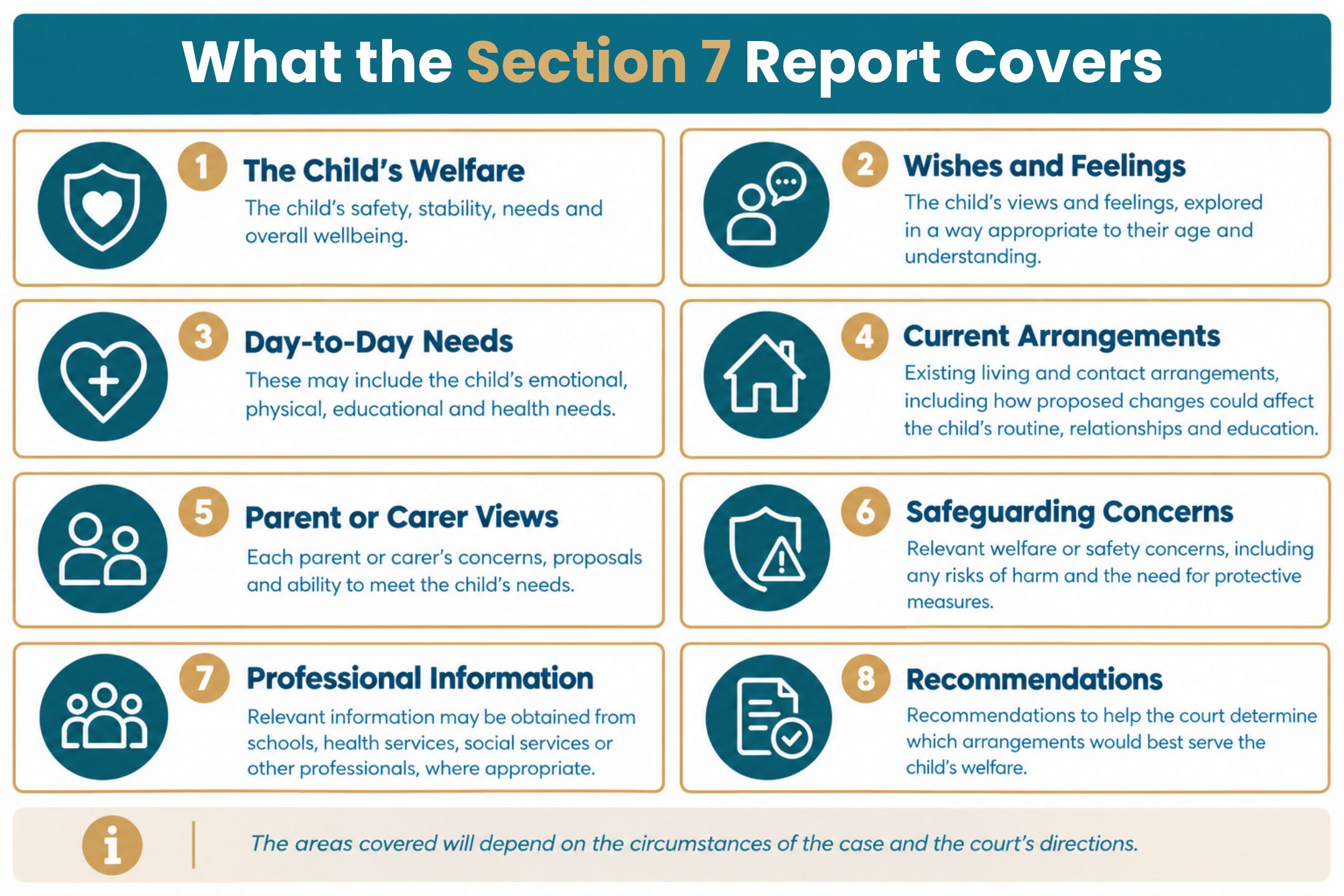
The Children Act 1989 welfare checklist is central to this assessment. The court and report writer will consider factors such as the child’s wishes and feelings, their physical, emotional and educational needs, the likely effect of any changes and any harm they have suffered or may be at risk of suffering.
A section 7 report can include:
- Information from meetings with each parent or guardian
- The child’s own wishes and feelings, taking account of their age and understanding
- Information from the child’s school, health professionals or relevant family members
- Safeguarding concerns or risks that need to be considered
- The child’s current routine, relationships and wider needs
- Recommendations about child arrangements or other welfare issues
Once the court orders the report, Cafcass usually allocates a Family Court Adviser and contacts the people involved. The process often involves separate discussions with each parent, and the adviser may also meet the child in a suitable setting such as school or another neutral venue. For younger children, the adviser may observe them with a parent or carer to understand their relationships and needs. No child should be asked to choose between parents. Their wishes and feelings are one part of the overall welfare assessment, not the deciding factor.
Approach your meeting with the adviser calmly and focus on your child’s needs. You may want to explain:
- What is working well for your child
- Any practical difficulties with the current arrangements
- Your concerns about welfare or safety
- The arrangements you believe would best meet your child’s needs
- Any information you think the Family Court Adviser should consider
You should not feel that you need to prepare for this alone. Our solicitors can help you understand what the court has asked Cafcass to consider and how to set out your concerns clearly.
Domestic abuse and risk in a section 7 report
If domestic abuse is a feature of your case, it is important that this is understood and properly considered. Raising these concerns in a formal court process can feel daunting, but the legal framework is designed to ensure the court takes them seriously.
Practice Direction 12J sets out the approach the court must take where domestic abuse or a risk of harm is raised in child arrangements proceedings. Where allegations are disputed and need to be resolved first, the court usually will not request a section 7 report until after any fact-finding hearing, so the report writer has a clear factual basis for their assessment.
Where domestic abuse is relevant, the report will consider the effect on the child and on the parent caring for them. This can include controlling or coercive behaviour, emotional abuse, threats, harassment or other conduct affecting a child’s safety and wellbeing.
If this applies to your situation, explain your concerns clearly to the Family Court Adviser. Keep records or gather documents only where it is safe to do so. A solicitor can advise you on how to raise these concerns effectively in the proceedings and whether protective orders or legal aid may also apply to your case.
How long does a section 7 report take?
Timelines vary by case and depend on the court’s directions, the issues in the case, and the availability of Cafcass or the local authority. The court will normally set a date for the report to be completed and filed, which is often several weeks after the order is made.
The process can take longer if there are complex safeguarding concerns, a need to obtain information from other professionals, or if further hearings are required. The Family Court Adviser may also need time to speak with the child and both parents before reaching a recommendation.
In most cases, you will receive the report before the next hearing. Cafcass states that the Family Court Adviser will usually share their thinking and recommendations with the family before filing the report with the court.
What can I do if I disagree with a section 7 report?
It can be difficult to read a report that doesn’t reflect your experience or recommends arrangements you do not believe are right for your child. It is important to know that disagreeing with the report does not mean the outcome is fixed. The court makes the final decision, and your response to the report is an opportunity to ensure the judge understands your perspective.
Rather than simply stating that you disagree with the outcome, focus on the specific points you want to challenge.
If you identify factual errors, such as an incorrect date, name or account of an event, you can raise these with the Family Court Adviser or their manager. Cafcass advises parents to tell their solicitor and the court if they are unhappy with the report, so the court can consider concerns before making a decision.
In many cases you will also be able to file a written statement before the hearing. This should set out clearly:
- Which parts of the report you disagree with
- Any factual inaccuracies or missing information
- Why you believe the recommendation does not meet your child’s welfare needs
- Any evidence that supports your position
- What arrangements you are asking the court to consider instead
A solicitor can help you structure your response in a focused and constructive way. They can also represent you at the hearing and, where appropriate, ask questions about the report.
Legal aid and advice about section 7 reports
Legal aid may be available for private law children proceedings where there is prescribed evidence of domestic abuse or child protection concerns and the relevant financial and merits tests are met.
You do not need to have all the evidence in place before speaking to a solicitor, though you will usually need it before legal aid can be formally confirmed. Evidence can come from several sources, including the police, a health professional, a domestic abuse support service, a MARAC (Multi-Agency Risk Assessment Conference), the court, or children’s services.
If you are unsure what a section 7 report means for your case, or how to respond, getting advice early can make a significant difference. National Legal Service can advise on child arrangements, section 7 reports, domestic abuse concerns and legal aid eligibility. Contact us to discuss your situation in confidence.